
Marble-Look Porcelain vs. Real Marble: Getting the Look Without the Maintenance
Marble has been a symbol of luxury in home design for centuries, and that appeal hasn't faded. What has changed is how people are achieving that look. Marble-look porcelain has become the practical alternative to real marble in a huge number of homes, and once you understand the differences, it's easy to see why.
The look: how close is close enough?
Modern printing and manufacturing technology has made marble-look porcelain remarkably convincing. High-resolution imaging techniques replicate the veining, color variation, and even the subtle texture of natural marble in ways that are genuinely difficult to distinguish from the real thing, especially once installed and viewed as a full room rather than a single sample.
Real marble does have something porcelain can't fully replicate: true natural variation, where no two slabs (or even two areas of the same slab) are identical. If that one-of-a-kind uniqueness matters most to you, real marble still has an edge. But for the vast majority of people, marble-look porcelain delivers a look that's visually indistinguishable in day-to-day life.
Durability
This is where the two materials diverge sharply.
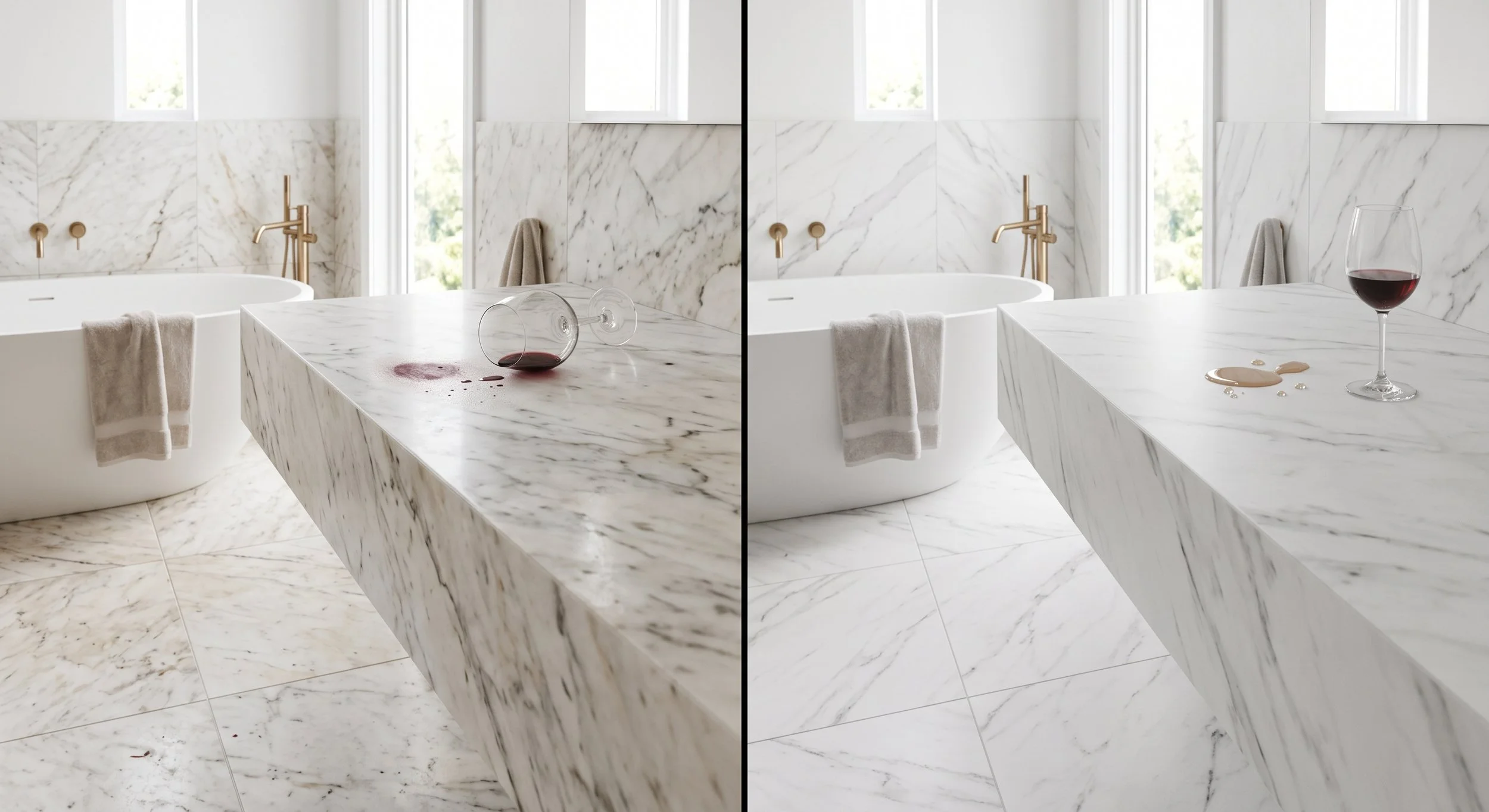
Real marble is a porous natural stone. It's vulnerable to staining, especially from acidic substances like wine, citrus, or even certain cleaning products. It can also etch (a dulling or discoloration) when it comes into contact with acids, and it's softer than porcelain, making it more prone to scratching and chipping over time.
Marble-look porcelain is fired at extremely high temperatures, making it dense, non-porous, and far more resistant to staining, scratching, and etching. It performs consistently well in kitchens, bathrooms, and high-traffic areas without the vulnerabilities that come with natural stone.
Maintenance
Real marble needs regular sealing, sometimes as often as every 6-12 months depending on use, to maintain its stain resistance. Even with proper sealing, care still has to be taken with acidic spills and certain cleaning products.
Marble-look porcelain needs essentially no special maintenance beyond regular cleaning. No sealing, no special cleaning products, no need to worry about a dropped lemon slice ruining your countertop or floor.
Cost
Real marble pricing varies significantly depending on the specific stone, its origin, and how it's cut, but it's generally a premium material with premium pricing, and that's before factoring in the ongoing cost of sealing and maintenance over time.
Marble-look porcelain is manufactured rather than quarried, which typically makes it considerably more budget-friendly, with far more predictable pricing across a consistent product line.
Where each makes sense
Real marble still makes sense for buyers who specifically want the natural, one-of-a-kind material and are prepared for the sealing and care it requires, often in lower-traffic, decorative applications like a feature wall or a statement piece rather than a high-use kitchen floor.
Marble-look porcelain makes sense for nearly everyone else, especially in high-traffic areas, kitchens, bathrooms, and any space where durability and low maintenance matter as much as appearance. It's also the more practical choice for large-format installations, where the cost difference between materials becomes more significant.
The bottom line
Marble-look porcelain exists because it solves a real problem: people love the look of marble but don't want the fragility, staining risk, and ongoing maintenance that comes with the real material. For most homes, it delivers essentially the same visual impact with a fraction of the upkeep and a more accessible price point, which is exactly why it's become the default choice in modern design.