
Large-Format Tile Trends: Why 60x120cm Is Taking Over Modern Homes
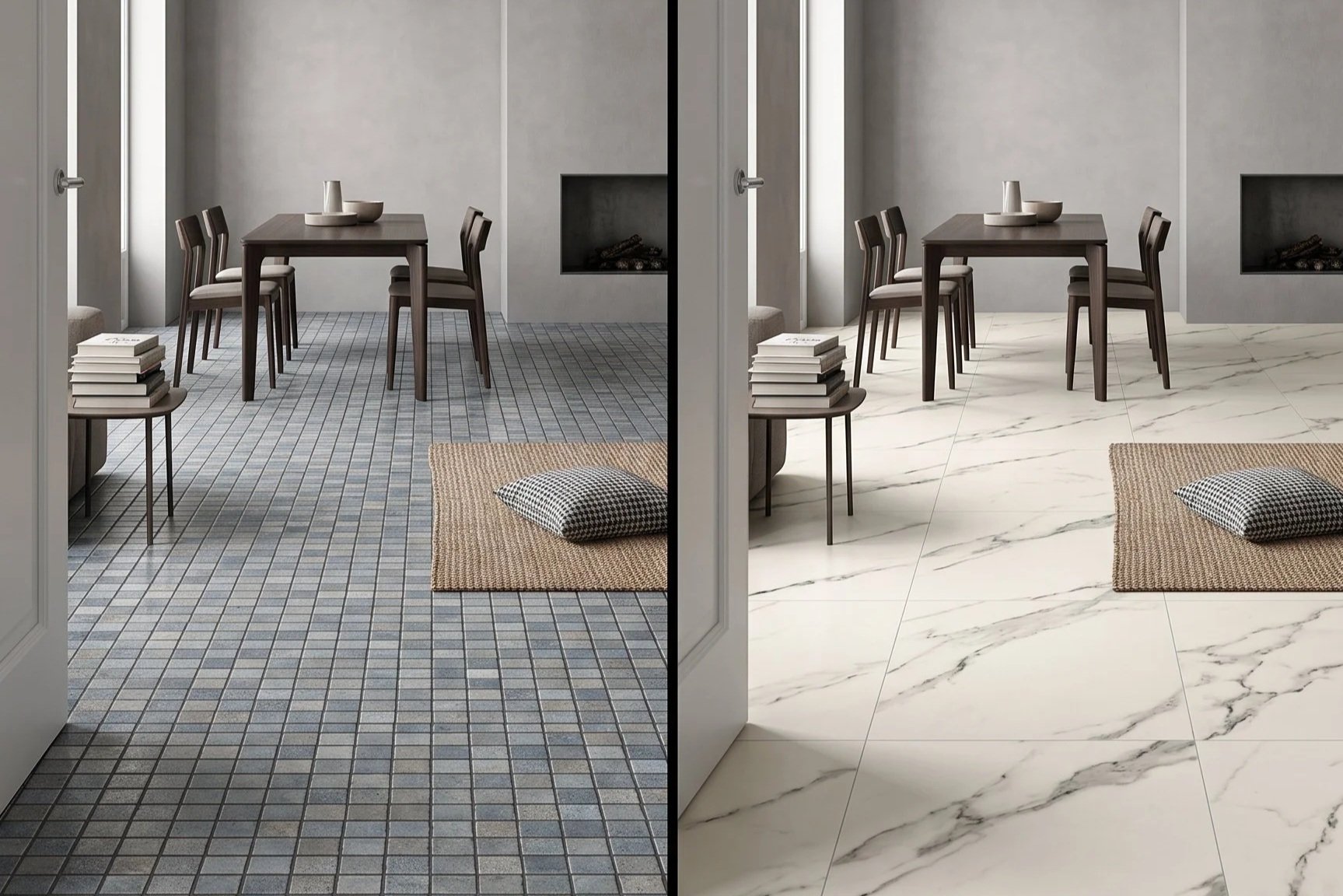
Walk into almost any newly renovated home or modern build over the past several years, and you'll likely notice the same thing underfoot or on the walls: large-format tile. What used to be a niche, higher-end choice has become close to the default in contemporary design. Here's why.
What counts as "large-format"
Traditional tile sizes like 30x30cm or 45x45cm have been the standard for decades. Large-format tile refers to anything significantly bigger, with 60x120cm being one of the most popular sizes in that category. Some collections go even larger, but 60x120cm has become a particular sweet spot: big enough to deliver the large-format look, manageable enough for straightforward installation.
Fewer grout lines, cleaner look
This is the single biggest reason large-format tile has taken over. A room tiled in 30x30cm tile has significantly more grout lines than the same room tiled in 60x120cm. Grout lines create visual breaks, and more breaks generally read as busier, more fragmented, and, ironically, can make a room feel smaller rather than larger.
Large-format tile minimizes those breaks, creating a more continuous, uninterrupted surface that reads as more spacious and more deliberate.
Less grout to maintain
Grout lines aren't just a visual consideration, they're also a maintenance one. Grout can stain, discolor, and require periodic resealing or cleaning, especially in high-moisture areas like bathrooms and kitchens. Fewer grout lines means less surface area where that maintenance is needed, which is a real practical advantage over time, not just an aesthetic one.
Better for showcasing pattern and veining
Marble-look and stone-look porcelain have become hugely popular, and large-format tile is what makes those patterns actually work. A dramatic marble vein pattern gets chopped up and repeated awkwardly on small tiles, but on a 60x120cm tile, the pattern can flow more naturally across a larger surface, closer to how it would look on an actual slab of stone.
Layout flexibility
Unlike square formats, a rectangular format like 60x120cm can be installed multiple ways:
Horizontally, in a running bond or brick pattern, for a dynamic, less rigid look
Vertically, especially on walls, to visually stretch a room upward
In a stacked grid, for a more structured, architectural feel
That flexibility lets the same tile serve very different design goals depending on the room and the look you're going for.
Works both indoors and outdoors
Many large-format porcelain collections are engineered to perform well both indoors and outdoors, meaning the same tile family (or a closely related finish) can carry through from an interior floor to an outdoor patio or pool deck. That continuity between indoor and outdoor spaces, popular in modern Florida design, is much easier to achieve with large-format tile than with smaller traditional formats.
Is it right for every space?
Large-format tile isn't automatically the right choice everywhere. Very small, irregularly shaped rooms with lots of corners and fixtures can mean more cuts and more waste with large tile, sometimes a smaller or mid-size format is more practical there. But for most standard rooms, from open living areas to bathrooms to outdoor patios, the shift toward large-format tile reflects a genuine improvement in how finished spaces look and how much upkeep they require, not just a passing trend.