
How Fast Can You Have a Pool Ready to Use in Miami?
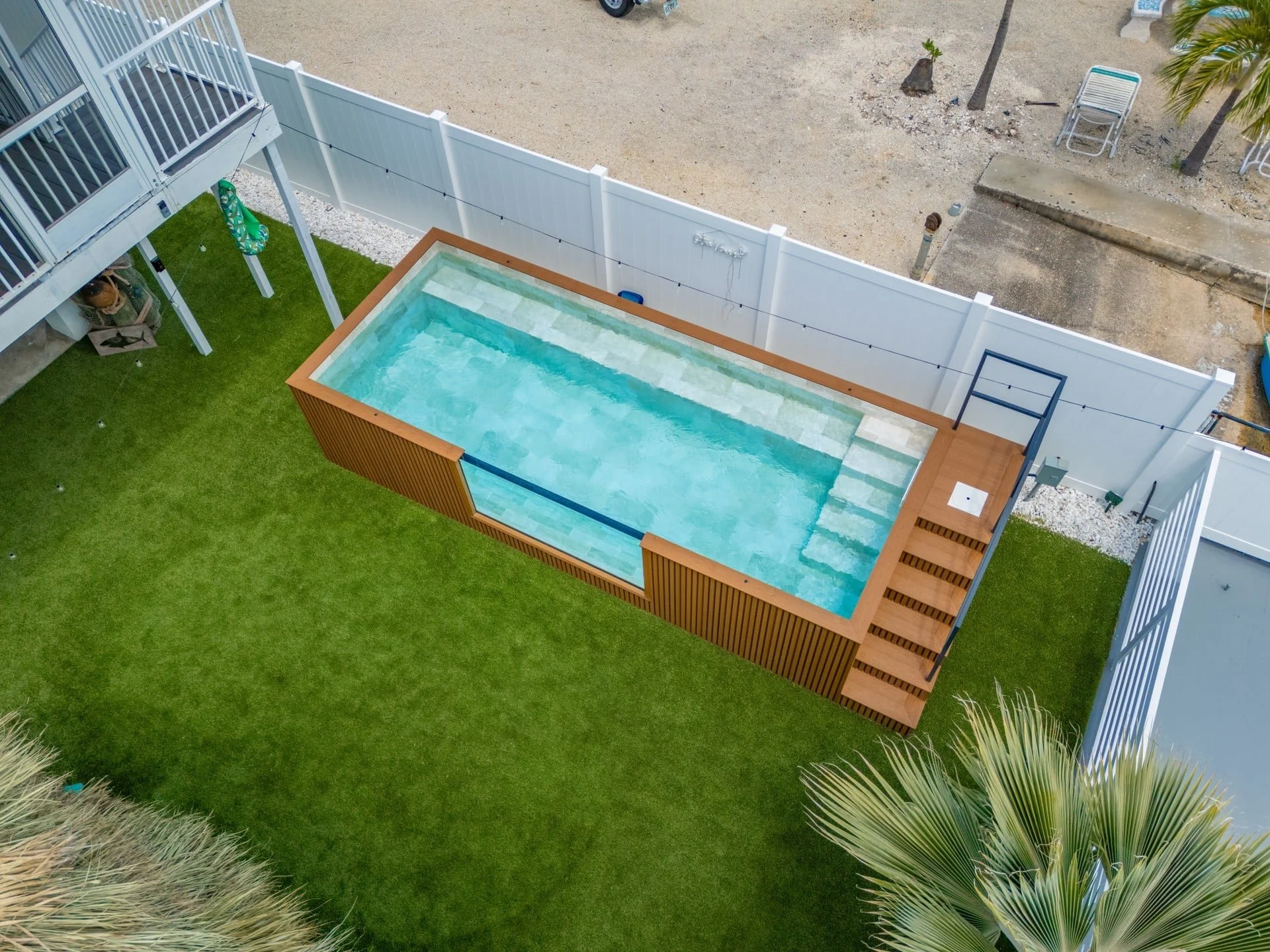
If you've ever looked into installing a traditional in-ground pool in Miami, you already know the timeline: permitting, excavation, inspections, weather delays, and often months before you're actually swimming. For a lot of homeowners, that timeline alone is enough to put the whole idea on hold. Above-ground boutique pools work differently, and the difference comes down to how they're built.
Why traditional pools take so long
In-ground pool construction typically involves:
Permit applications and approval, which can take weeks or longer depending on your county or city
Excavation and site work
Structural construction (forming, rebar, gunite or shotcrete, curing time)
Plumbing, electrical, and equipment installation
Decking and finishing work
Multiple inspections at different stages
Each of these steps depends on the one before it, and weather, permitting backlogs, or contractor scheduling can push the timeline out further. It's not unusual for a traditional pool project to take several months from start to finish.
Why above-ground pools skip most of that
Boutique above-ground pools are built differently from the ground up, literally. Instead of being constructed on-site over weeks or months, they arrive as a ready-to-install structure with the pool shell, filtration system, lighting, and glass panel already engineered as one unit. Installation is designed to be plug-and-play.
That difference matters because:
No excavation means no waiting on site work or dealing with unpredictable ground conditions
No permits required for most installations means you skip one of the biggest bottlenecks in traditional pool projects
Pre-engineered systems (filtration, lighting, climate control) come integrated, rather than needing to be installed and tested separately on-site
What "ready to use" actually looks like
Because the structure itself doesn't need to be built on-site, the process is much closer to placing and connecting a finished product than constructing one from scratch. In practice, that means:
The site is prepared (the ground needs to be level; exact requirements depend on the pool model)
The pool structure is placed
It's connected to power and water
Filtration, lighting, and climate control systems are activated and tested
The pool is filled and ready to use
That's a fundamentally shorter process than pouring and curing concrete, then waiting on inspections at multiple stages.
Is an above-ground pool right for your timeline?
If you're hoping to have a pool ready for a specific season, an event, or just want to stop waiting and start enjoying your backyard, the compressed timeline of an above-ground boutique pool is one of the biggest practical advantages over traditional construction. Combined with the fact that it doesn't require the same level of site disruption (no heavy excavation equipment tearing up your yard for weeks), it's a meaningfully different experience from start to finish.
Timelines can vary depending on your specific site and pool model, so the best way to get a clear estimate for your property is to reach out directly.